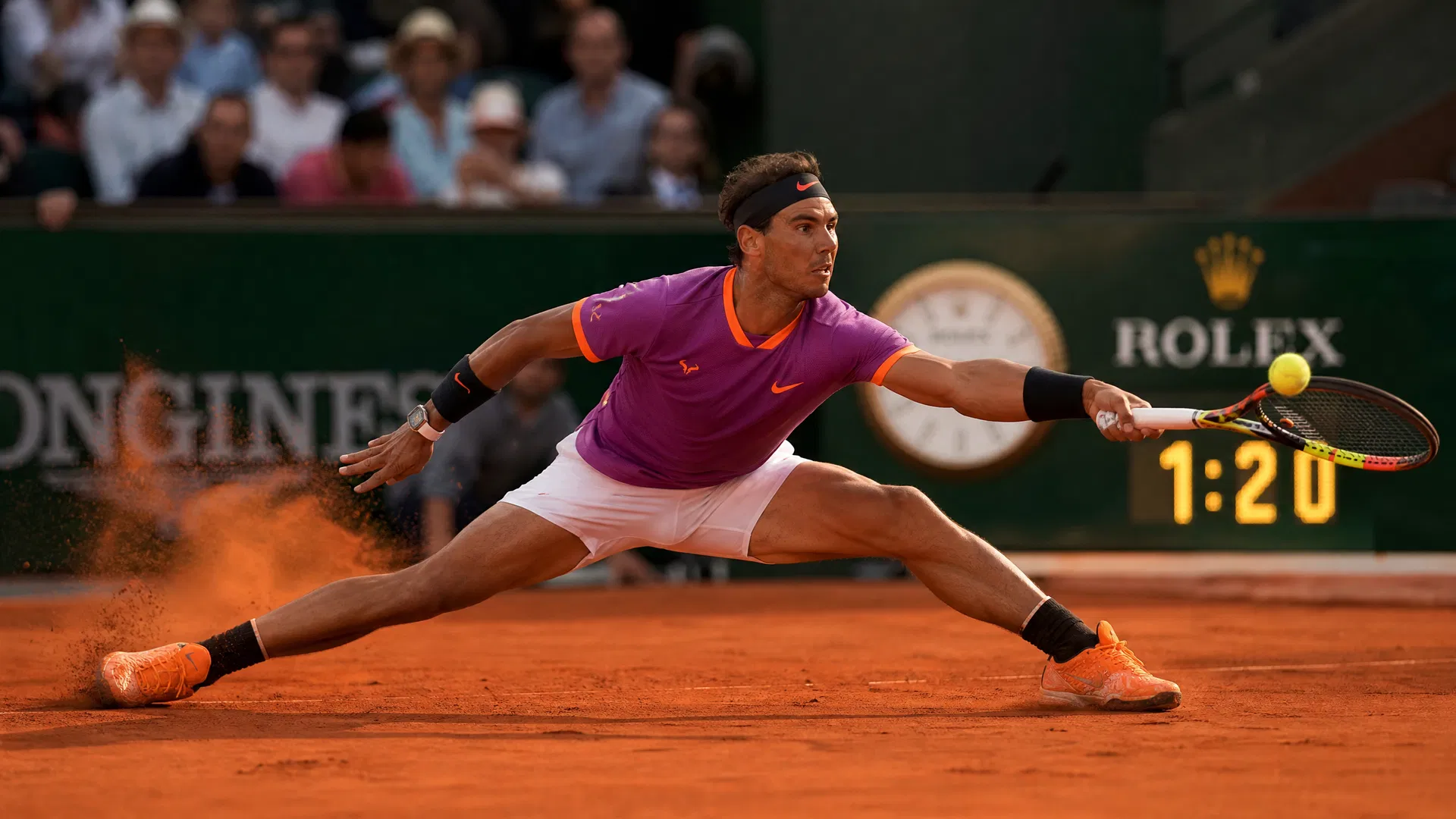
The split step is everything.
It happens in the fraction of a second before your opponent makes contact with the ball — a small hop that loads the legs and prepares the body to explode in any direction. Get it right and you're already moving before the ball has left the strings. Get it wrong and you're a step behind, and in tennis, a step behind is the point.
The split step is a phosphocreatine event. So is every first move that follows it.
Tennis is misclassified as an aerobic sport. The aerobic system is important — it powers the recovery between points and the baseline rallies that make up most of a match. But the explosive actions that determine outcomes — the first step to a wide ball, the acceleration into the net, the overhead at full extension, the serve at 130 miles per hour — are powered by the ATP-phosphocreatine system. And in a five-set match that lasts four hours, those explosive actions happen hundreds of times.
The player who is still moving with first-step quickness in the fifth set has not just trained harder. They have optimized something cellular.
Creatine research supports repeated high-intensity work capacity and training adaptation across athletic settings. The relevance to tennis is the repeated explosive pattern — not a promise that supplementation determines a late-match result.
There is also the cognitive dimension. Tennis is a decision sport. Controlled studies in non-tennis populations suggest creatine may support selected cognitive measures under mental fatigue or sleep deprivation. That evidence is promising, but it does not establish that a player will read the fifth set better because of a supplement.
CELL/T delivers five grams of micronized creatine monohydrate with sodium, potassium, magnesium, and two grams of taurine. It supports a consistent creatine and hydration routine; serve placement still comes from mechanics, repetition, and match preparation.
The score is two sets all. The fifth set is starting.
You split step.
You're already moving.
References
- McMorris T, Harris RC, Swain J, et al. Effect of creatine supplementation and sleep deprivation, with mild exercise, on cognitive and psychomotor performance. Psychopharmacology. 2006;185(1):93-103. doi:10.1007/s00213-005-0269-z
- Rae C, Digney AL, McEwan SR, Bates TC. Oral creatine monohydrate supplementation improves brain performance. Proc R Soc Lond B. 2003;270(1529):2147-2150. doi:10.1098/rspb.2003.2492
- Kreider RB, Kalman DS, Antonio J, et al. International Society of Sports Nutrition position stand: safety and efficacy of creatine supplementation. J Int Soc Sports Nutr. 2017;14:18. doi:10.1186/s12970-017-0173-z